


By Robert Friend, Principal Engineer, Enterprise Network Marketing, Marvell
Multivendor environments have been the norm for decades to accelerate innovation, lower costs, and enable customers to optimize infrastructure with best-of-breed technologies.
But are there still hidden advantages going with a vertically integrated vendor?
Marvell, Dell and Cisco set out to answer this question in storage networking by submitting two SAN solutions to Tolly, a technical benchmarking service: the Dell PowerStore 32G Enterprise Storage Solution1 and the Dell PowerMax 64G Enterprise Storage Solution.2 The solutions combine Marvell® QLogic® 32G and 64G Fibre Channel HBAs with Dell PowerEdge 17G servers, Connectrix MDS Switches and Directors, as well as PowerStore and PowerMax storage.
Tolly found the systems delivered on seamless interoperability. More importantly, the technologies from the individual vendors such as highlighting the SAN congestion mitigation and comprehensive security.
Better together, in other words, is better. The set-up and the test results are below.
FPINs and Virtual Lanes Offer Interoperability and Compatibility
The solutions offer comprehensive 32/64G Fibre Channel (FC) interoperability, making the solution easy to adopt for storage networking applications in the data center.
The features are also plug-and-play compatible for seamless experience. The Marvell Fabric Performance Impact Notification frames (FPINs) and Virtual Lanes (VLs) for SAN endpoint connections, for example, pair well with Connectrix MDS’ Dynamic Ingress Rate Limiting (DIRL) inside the FC storage area network (SAN). Marvell HBAs uniquely offer these VLs, which are compatible with all FC switches, including solution partner Cisco.
By Todd Rope, Vice President of Software Engineering, Marvell, and Wesley Yeh, UI Architect, Marvell
Interconnects have become one of the fastest growing markets in AI as hyperscalers race to expand their infrastructure. Annual port shipments and revenue for high-speed cables (100G and above) are expected to grow by 42% and 39% through 2030, respectively, reaching a cumulative 1.4 billion units, according to research firm LightCounting.1 That surpasses the unit and revenue growth rates for GPUs, CPUs, memory devices and other major components.2
As data center interconnects extend in reach and increase in speed, their impact on total cost of ownership and return on investment will only intensify. Achieving optimal performance at scale requires live visibility into interconnect fabrics.
Marvell RELIANT (Reliable Link Analytics and Intelligence) is a new software platform that improves network health through real-time intelligence across scale-up, scale-out, and scale-across networks. Tapping into live operational data at the silicon level, RELIANT enables data center operators to visualize and monitor interconnects, conduct diagnostics and proactively prevent link flaps and other problems that can lead to downtime.
By Jianping Jiang, Head of Product Marketing, CXL Switch, Marvell
The AI memory wall—the widening gap between the memory capacity and bandwidth AI infrastructure wants and the amount that conventional memory architectures can deliver—is accelerating at an alarming pace.
And the consequences are getting increasingly ominous for data center operators and their customers: idle XPUs, underutilized equipment, longer processing times, higher costs, and ultimately a lower return on investment. Meanwhile, memory—already second only to GPUs in datacenter semiconductor spend1—continues to soar in price.
The Marvell® StructeraTM S family of Compute Express Link (CXL) switches scale the memory wall by providing a pathway for adding terabytes of shareable memory to infrastructure and dynamically allocating bandwidth and capacity to boost utilization and application performance. CXL switches don’t just boost memory and memory capacity; they enable data center operators to use it more wisely too.
Structera S is the successor to the groundbreaking Apollo line of CXL switches developed by XConn Technologies, now part of Marvell. Structera S 20256 for PCIe Gen 5.0/CXL 2.0 (previously the XConn Apollo I) became the first commercially available CXL switch upon its release last year.
Marvell is expanding the family with Structera S 30260 for PCIe 6.0/CXL 3.x. Structera S 30260 features support for 16 or 32 CPUs or GPUs over 260 lanes with up to 48TB of shared memory and 4TB/second cumulative bandwidth. Marvell is showcasing Structera S 30260 in a live demonstration this week at OFC 2026 and plans on sampling to customers in 3Q 2026.
By Krishna Mallampati, Senior Director of Product Marketing, Data Center Switching, Marvell
Since its introduction in 2004, PCIe® has become the most popular interconnect for low-latency chip-to-chip connections. From its humble beginnings for fan-out interconnects, PCIe has been integrated into AI and cloud servers, JBOF storage systems, ADAS systems in automotive, industrial automation, PCs, and other platforms.
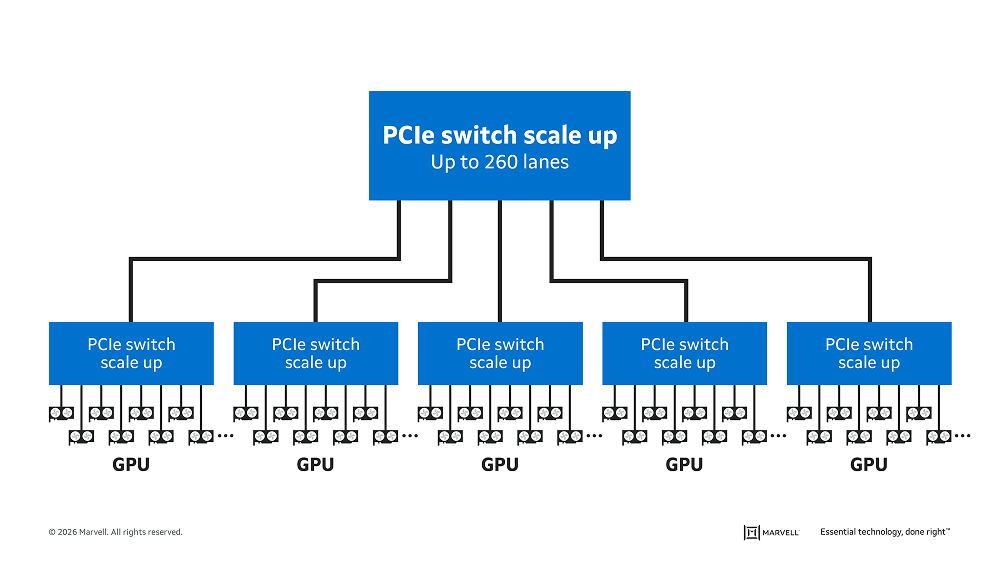
Scale-up AI servers—which can contain hundreds of processors spread over multiple racks—represent the next logical step for PCIe. Although far larger than today’s single chassis AI servers, scale-up servers demand the same thing from interconnect fabrics: coherent, low-latency links that enable fast, secure communication between components. PCIe’s status as a widely-used standard that evolves to meet customer demands further puts it in the forefront for scale-up.
Let’s explore the PCIe scale-up usage model and how these architectures will evolve.
PCIe Scale-up Usage Model
By Henry Chen, Senior Director, Optical DSP Marketing, Marvell
In AI infrastructure, every electron matters.
That is the underlying principle behind Marvell® Ara T, the industry’s first 1.6T transmit-only (TRO) optical digital signal processor (DSP) for AI and cloud interconnects. Designed for high-bandwidth, mid-length links spanning 5 to 500 meters, Ara T can reduce optical power module power consumption by more than 35%, delivering meaningful savings at scale.
Ara T extends Marvell leadership in 1.6T optics and interconnect technology and advances the company's strategy to raise infrastructure ROI and efficiency through optimized silicon.
Marvell will showcase Ara T at OFC 2026 in Los Angeles, March 17–19.