
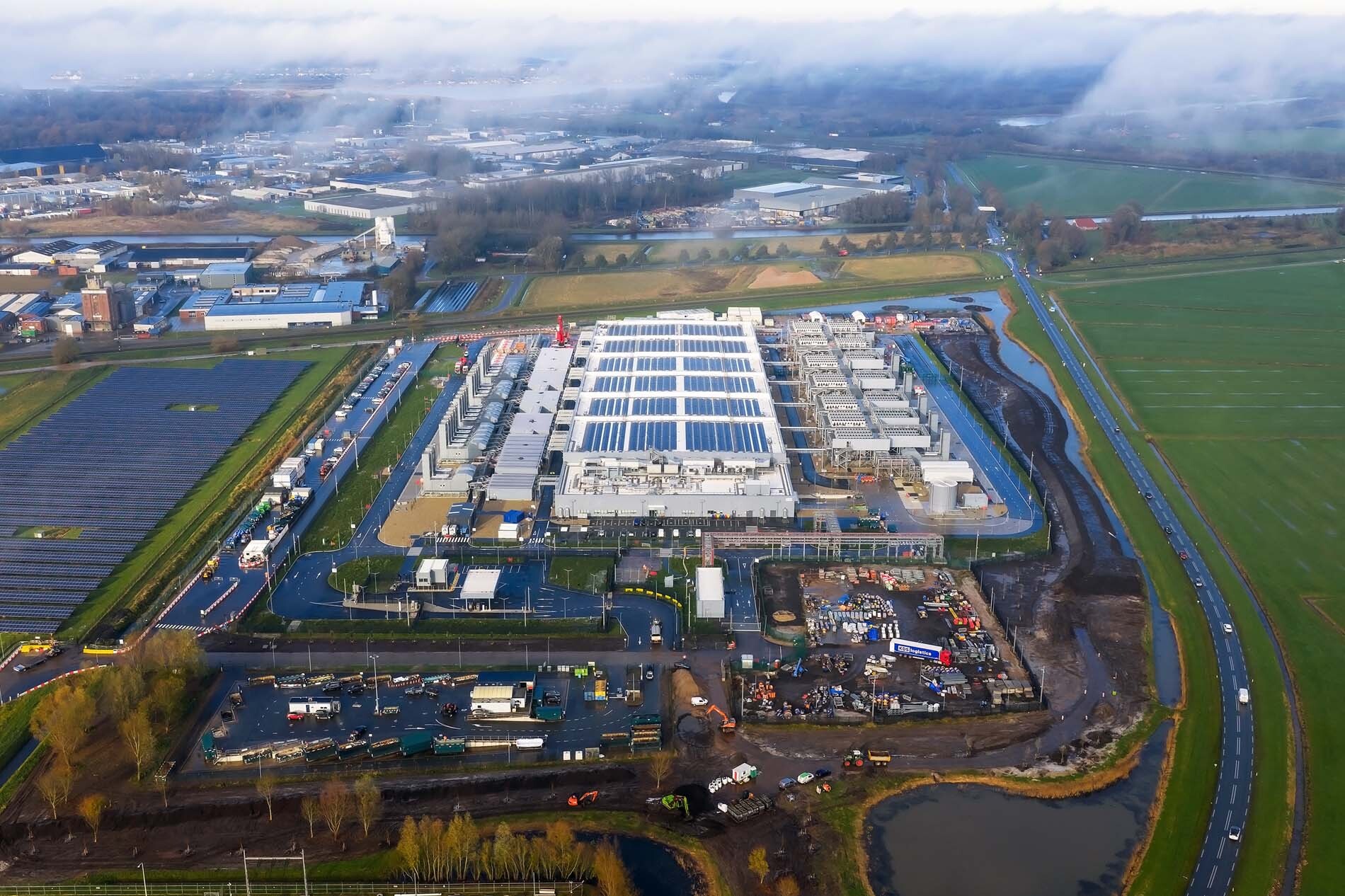
AI workloads have outgrown the power, space, and cooling any single facility can provide. Scale across is how Marvell connects separate data centers so AI infrastructure can keep growing, — from neighboring buildings to sites across a region, into a single logical campus.
A single site can no longer supply the power and space the largest AI workloads demand. The answer is to distribute compute across multiple data centers and connect them, so AI infrastructure can keep growing past the limits of any one facility. Scale across delivers that connectivity — securely, and at the bandwidth AI workloads require over the fiber between sites.

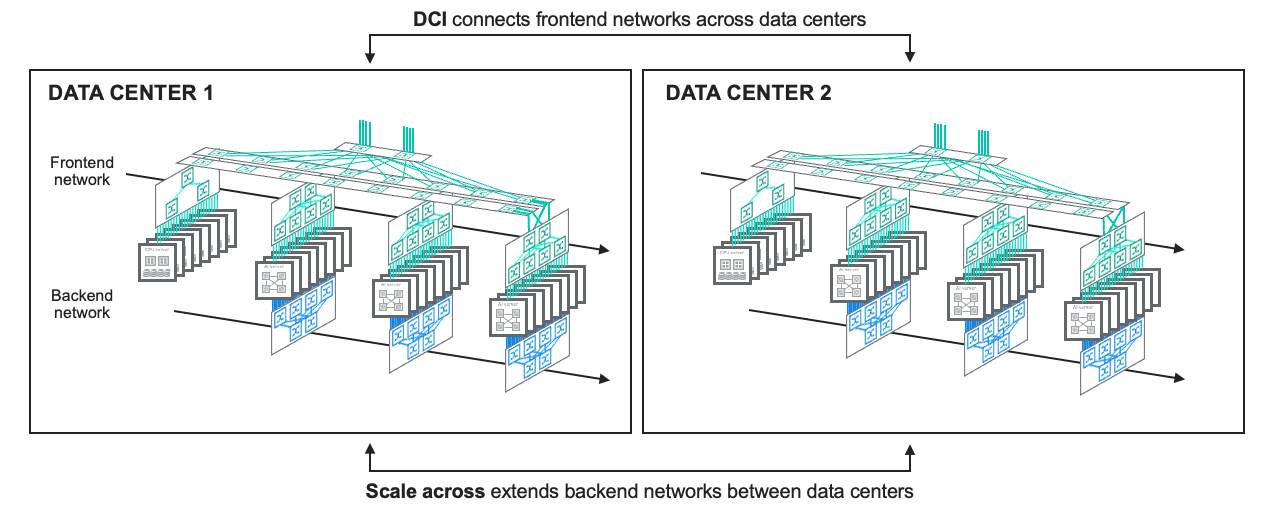
Data center interconnect (DCI) has long connected data center sites over fiber. Scale across does the same thing. The difference lies in the parts of the data center they connect. DCI connects frontend networks across data centers, whereas scale across connects and backend networks. DCI and scale across connect different parts of the data center, serve different workloads, and place very different demands on the connection between sites.
| DCI | Scale across | |
| What it connects | The frontend networks of separate data centers. | The backend networks of separate data centers — the XPU compute fabric itself. |
| Why it exists | Built to connect the frontend for CPU and storage. As LLM training arrived, it grew the DCI market further. | Inference and agentic workloads need their own connection to join XPU clusters in different data centers into one much larger cluster. |
| Driving workload | CPU and storage, then LLM training. | Inference and agentic AI. |
| What it produces | Data centers linked together. | Multiple data centers fused into a single, larger AI cluster. |
| Demand on the link | Lighter capacity; more latency-tolerant. | Heavier capacity; more latency-sensitive. |
Scale across is the connectivity that extends AI infrastructure beyond a single data center. It can be implemented in the form of DCI, which connects the frontend networks of separate sites, or backend scale across, which connects their backend compute fabrics into one larger cluster.

Coherent DSPs
Marvell Coherent DSPs power the longest-reach connections, converting high-capacity electrical signals into coherent optical links that carry AI traffic across regional distances with industry-leading efficiency. They are foundational to every Marvell® COLORZ® module, with millions shipped to date.
Coherent-lite for shorter reach
For campus and edge-of-metro links, coherent-lite delivers coherent-class reach at lower power and cost. Marvell O-band-optimized coherent-lite DSPs are purpose-built for the emerging interconnect tier between pluggable PAM4 and full long-haul coherent.
Pluggable coherent modules
COLORZ 400 and 800 ZR/ZR+ pluggables bring coherent optics into standard switch and router ports, so operators can scale across sites without dedicated transport gear. Announced, COLORZ 1600 pluggable modules will deliver the bandwidth next-generation data centers require.
Open and interoperable
COLORZ modules and Marvell coherent DSPs are built to OpenZR+ and industry standards for multi-vendor interoperability, protecting operators from lock-in as they scale.

Learn More

Learn More

Learn More

Breadth and maturity across every distance. Marvell provides coherent DSPs for the longest regional reach, coherent-lite DSPs for campus and edge-of-metro links, and COLORZ ZR/ZR+ pluggable modules that drop coherent optics straight into standard switch and router ports, with Teralynx switch silicon at either end. Marvell coherent DSPs are foundational to every COLORZ module, with millions shipped to date, and the portfolio is built to OpenZR+ and industry standards for multi-vendor interoperability. End-to-end coverage— campus, metro, and regional, from one vendor, with integrated MACsec security—is the differentiator.
Scale across is the connectivity that extends a single AI cluster beyond one data center — across a campus, metro, or region — so infrastructure can keep growing when a single site runs out of power, space, or cooling.
DCI and scale across are terms commonly used interchangeably to describe connectivity between data center building or sites. DCI has long connected frontend networks between data centers and was developed to serve CPU, storage and, more recently, LLM training. It carries lighter, more latency-tolerant traffic. Backend Scale across is a newer term associated with connecting backend compute fabric between data centers for inference and agentic workloads. It carries heavier, more latency-sensitive traffic — roughly 10x the bandwidth of DCI — and must behave like an extension of the compute fabric itself.
Because it carries collective traffic on the critical path, every kilometer of distance turns into latency the workload feels directly, and it must be near-lossless and deterministic. DCI can absorb latency, loss, and jitter that backend scale across cannot.
Scale out connects racks within a single data center. Scale across connects data centers to each other. Scale across is the longest-reach tier — it begins where scale out ends.
Coherent ZR is a class of specifications (e.g., 400ZR, 800ZR) known as an implementation agreement (akin to a standard) developed under the auspices of the Optical Internetworking Forum (OIF) for optical devices that use advanced modulation and digital signal processing to transmit data at high-bandwidth over long distances. ZR+ refers to similar specifications developed under the auspices of the OpenZR+ MSA group that are optimized for long-haul (100s of kilometers) use cases.
Distance introduces latency to a link, which must be managed through system design and workload placement.
Marvell coherent DSPs and coherent-lite DSPs with integrated MACsec security. COLORZ 400, 800 and 1600 ZR/ZR+ pluggable coherent modules spanning campus, metro, and regional distances and built to OIF and OpenZR+ standards for multi-vendor interoperability. Marvell® Teralynx® switch silicon powers switch systems used at either end of a scale-across link.
We believe better partnerships help to build better technologies. Let’s connect and see what we can design together!
We will be in touch with you soon!


