


By Eyal Worthalter, Director, Security Sales, Marvell
For more than a decade, the cloud has been rewriting the rules of cryptographic security. Signing, certificate management, tokenization and encryption key management have all found their way from on-premises hardware security modules (HSMs) into fully managed cloud services. But one corner of the HSM world has stubbornly resisted that shift: payments.
Until now, there has been no true cloud HSM for payments. That is changing with Azure Cloud HSM v2, a new offering built jointly by Marvell, Microsoft and Utimaco, entering public preview in September 2026.
To understand why this matters, it helps to look back at where payment security came from, and why it took a different path than the rest of the cryptography world.
Where It All Started: The Atalla Box
This is the payments chapter of a much broader evolution in Azure key management. Azure began by making HSM backed key protection available as a shared cloud service, expanded to dedicated HSM appliances for customers requiring exclusive hardware control, and then evolved toward cloud-native, single-tenant HSM services that deliver tenant isolation, customer control, and cloud-scale operations without requiring customers to manage the underlying hardware. Azure Payment HSM v2 extends that evolution to the highly specialized world of payment cryptography.
By Ravi Mahatme, Senior Director, Product Management, Photonic Fabric Business Unit, Marvell
AI infrastructure is entering a new architectural era. As AI inference scales, performance increasingly depends not simply on adding more compute, but on how efficiently compute, memory and connectivity operate together as one unified AI infrastructure system. Modern AI inference workloads are insatiable consumers of memory. Large language models, reasoning models and agentic AI applications require rapid access to model parameters, embeddings and rapidly growing key-value (KV) caches that preserve conversational context. These working data sets are growing into the hundreds of gigabytes, and increasingly terabytes, making memory capacity, bandwidth and latency just as important as accelerator performance. As AI infrastructure scales, overall system performance increasingly depends on how efficiently accelerators can access, move and utilize memory resources rather than simply adding more compute.
Why AI Needs a New Memory Tier
Today's AI memory hierarchy was never designed for inference at the scale modern workloads demand. High bandwidth memory (HBM) attached directly to GPUs delivers exceptional performance but remains expensive and capacity constrained. System DRAM provides larger memory pools but cannot economically scale alongside every accelerator. NVMe SSDs offer abundant capacity, yet their latency makes them unsuitable for serving active inference workloads.
This challenge is especially visible in large language models, where growing KV caches must remain readily accessible to avoid repeatedly recomputing previous tokens. Keeping these caches entirely in HBM is prohibitively expensive, while moving them to storage introduces latency that reduces token generation performance. The result is that GPUs increasingly spend valuable cycles waiting for data rather than performing inference.
By Vikram Dattatri, Senior Engineer, Cloud Platform Group, Marvell
Packet trimming doesn’t prevent traffic losses from occurring; instead, it streamlines the process for recovering them. It is also one of many technologies Marvell is developing to optimize networks for the AI era.
Artificial intelligence infrastructure is driving a fundamental shift in how data center networks are designed, validated, and deployed. As clusters scale to thousands—or even tens of thousands—of GPUs, the network is no longer just a connectivity layer. It becomes a tightly coupled component of the compute system, directly impacting job completion time, efficiency and overall cost.
To address these evolving requirements, Ethernet is undergoing a transformation. At OFC 2026, Marvell and Keysight Technologies demonstrated (see the video below) how next-generation Ethernet fabrics can meet the demands of AI workloads through a combination of advanced features and realistic validation. Leveraging Keysight’s KAI Data Center Builder and AresONE‑M 800GE platform, the collaboration showcased how the Marvell® Teralynx® switch fabric supports emerging Ultra Ethernet Consortium (UEC) capabilities, with a particular focus on packet trimming, Auto Load Balancing (ALB) and Ultra Ethernet Transport (UET).
By Arifur Rahman, Director of Product Marketing, Custom Cloud Solutions, Marvell
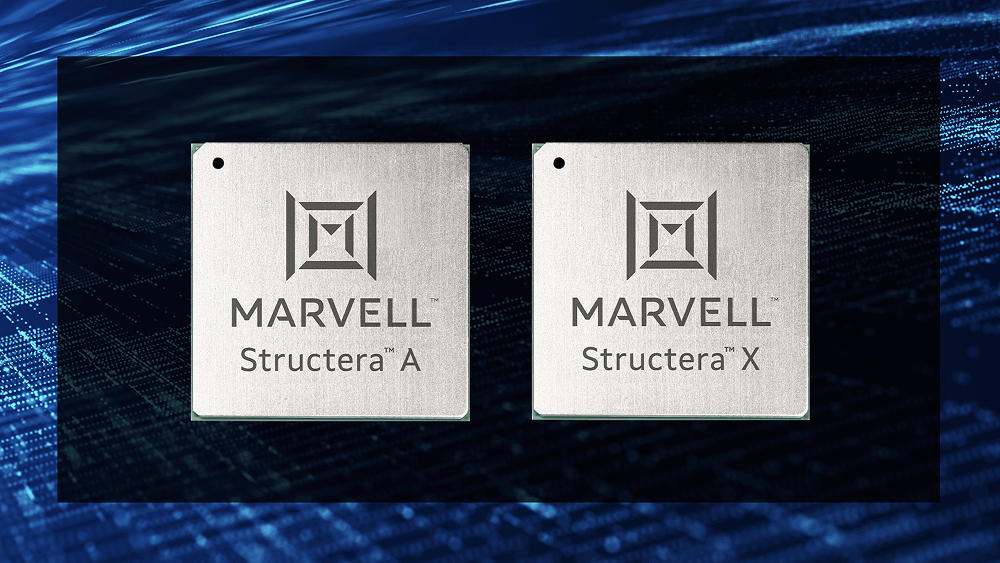
Modern AI workloads are insatiable consumers of memory. Deep learning recommendation models (DLRM), large language model (LLM) inference, in-memory databases and vector search engines all share a common bottleneck: there is never enough DRAM, and what exists is very expensive.
At today's spot prices—$27–$37 per GB for server-grade DDR5 RDIMMs1—a 12TB memory pool requires nearly half a million dollars in DRAM alone. Meanwhile, AI infrastructure buildouts are consuming server DRAM capacity faster than fabs can produce it, driving prices up 300–400% since mid-2025.1, 2
CXL memory expansion was supposed to solve this. And it does—but there's a subtler lever that most solutions ignore: the data sitting in that memory is compressible, and most CXL controllers don't touch it.
By Claudia Hoessbacher, Senior Director, and Wolfgang Heni, Director, Optical Engineering, Marvell
Plasmons have been used to accelerate drug discovery, enhance the sensitivity of sensors and even create artistic treasures in the Roman era.
Ongoing research at Marvell seeks to harness them to improve the performance of optical networks for the AI era. Plasmonics, a technology that leverages the properties of surface plasmon polaritons (SPPs), provides a promising pathway for enhancing the roadmap of silicon photonic (SiPho) light engines, a critical component inside optical modules.
Plasmonic-based SiPho light engines could support modules operating at 3.2T and beyond while consuming a fraction of the space and power per bit of modules based on existing technologies. Manufacturers could leverage foundry process technologies for scaling production.