
Scale up

Scale up couples accelerators into one compute domain. 

Scale up data center

Many accelerators become one compute domain


Scale up is the atomic unit of AI data center infrastructure. In the scale-up domain, dozens to hundreds of accelerators are connected inside a single rack so directly that the whole rack appears to AI software as one logical XPU—a single compute domain. Inside that rack, the goal is to connect as many processors as possible in a full any-to-any configuration, where every processor can talk directly to every other one.

Today, the connectivity inside that rack uses copper as the medium to carry data. Copper is reliable, inexpensive, low-latency, and draws little power. As models grow, the scale-up domain is spreading from one rack to several—rack scale to row scale. Copper can't reach that far, because for every bandwidth doubling, the distance copper can carry it is divided roughly in two. Crossing racks forces two changes at once: the longer links go optical, and a switching layer is required, because thousands of XPUs can't each be wired directly to all the others. Marvell builds the silicon for both—the interconnect and the switching—across every link inside a scale-up domain, copper and optical, on whichever protocol an operator prefers.

Here's how three macro-level distance domains compare: scale up makes many accelerators act as one domain. Scale out ties many of those domains into a cluster, and scale across connects clusters in separate data centers. The scale-up domain comprises —the highest-bandwidth, lowest-latency connections in the data center.
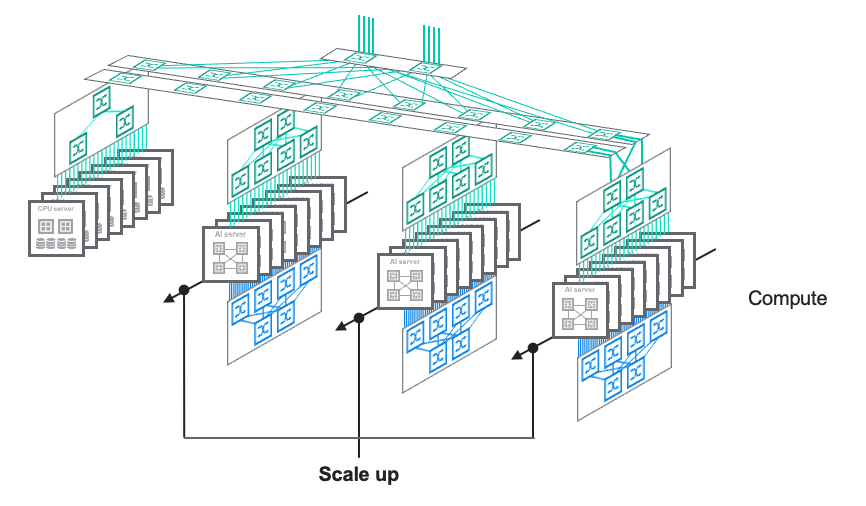
AI data center scale out connectivity


Scale up is the connectivity that couples accelerators into a single compute domain within a rack today and, increasingly, across several. It's the tightest, highest-bandwidth tier, where dozens to hundreds of accelerators act as one.
Two elements of scale-up networking: switching and interconnect


Scale-up connectivity has two elements, the same two behind every tier of the AI data center: the switching that ties the domain together into a fabric, and the interconnect that carries the signal between accelerators and switches. Switching comes down to a protocol. Interconnect comes down to a type: first copper or optical, then, for optical links, which kind of optics. Marvell builds silicon across all of it.

Which switching protocols does scale-up networking use?


The switching layer ties a scale-up domain together, and it runs on a protocol. Several are in play, and the industry hasn't settled on which will win. PCIe is in limited use today based upon widespread use in other applications. UALink and ESUN are newer open standards, built specifically for scale up, with switches maturing. Ethernet is filling in as a bridge until those are ready. NVLink is the most widespread use today, supported by Marvell through NVLink Fusion. Each one trades off bandwidth, latency, openness, and how ready it is to deploy. Different operators are making different choices based on their own architectures and priorities.

Marvell is developing the broadest range of scale-up switches in the industry, spanning these protocols in a single portfolio. So, an operator can pick whichever protocol fits the system and build it with Marvell silicon. That same portfolio spans merchant, semi-custom, and custom silicon, so it fits an operator buying a standard part as well as a hyperscaler co-designing its own XPU.

ProtocolRole in the scale-up domainMarvell silicon
PCIeGeneral-purpose protocol in limited use for scale up todayPCIe switches and retimers
UALinkOpen standard built for scale up; switches maturingUALink switches (in development, 1H27)
ESUN (Ethernet scale-up networking)Ethernet adapted for scale up; open, industry-backedESUN switches (in development, 1H27)
EthernetThe bridge today, until scale-up-native switches shipMarvell® Teralynx® T100 switch
NVLink-compatibleA supported path via NVLink FusionNVLink Fusion-compatible switching; custom XPUs


Ethernet plays a specific role today. UALink and ESUN switches are still maturing, so some operators run scale-up traffic over Ethernet now, often by encapsulating a protocol like UALink over Ethernet until native switches arrive. Ethernet is the bridge; ESUN is where Ethernet is headed for scale up. The Marvell® Teralynx® T100 switch fills the bridge role today: 102.4 Tbps of low-latency switching, the same switch silicon used in scale-out fabrics, applied to the scale-up domain.

Marvell can also build to NVLink Fusion, supplying NVLink Fusion-compatible scale-up connectivity and custom XPUs. It's one supported path among several.

Scale-up interconnect: copper inside the rack, optics across racks


Where switching comes down to a protocol, interconnect comes down to a media type with two separate choices.

Copper carries the scale-up domain today

The first choice is the choice of physical media: copper or optical (fiber-optic cable). Inside the rack, copper carries data in the scale-up domain today at low power and low latency over the meter or two between accelerators. What makes a copper link fast is the electrical SerDes at each end. SerDes is  — the signaling technology that drives the data across the wire, engineered at the scale-in layer beneath every node.

As a scale-up domain pushes to the limits of copper reach, co-packaged copper (CPC) extends it one more step. CPC drives signals with the same 224G SerDes straight from the package to the cable, skipping the loss of traditional board routing—the highest signal integrity and lowest power per bit inside the rack. It's the last copper packaging step before a link has to go optical.

Optics take the domain across racks.

Past that point, the longer links of a multi-rack domain have to go optical to hold the bandwidth and latency scale up needs. How the optics get built isn't settled either, so Marvell is developing several photonic approaches in parallel—Marvell® Photonic Fabric® technology, built using electro-absorption modulators (EAM), is one approach, alongside Mach-Zehnder modulators (MZM), micro-ring modulators (MRM), micro-LED, micro-VCSEL, and others. Each is instantiated as a photonic I/O chiplet. 

Marvell Photonic Fabric technology extends a scale-up domain well past copper's reach while holding scale-up performance—high bandwidth, low latency, and low power over distances copper can't span. The same technology carries an optical shared-memory tier across racks. 

Where the optics sit is a separate choice

One more choice sits alongside these, independent of protocol and optical technology: where the optics physically go. Optics can sit on the board (on-board optics, OBO), move onto the interposer next to the package (near-package optics, NPO), or go inside it (co-packaged optics, CPO). The tightest, densest scale-up links are where co-packaging pays off, placing a photonic chiplet beside the compute silicon. That's why the natural home for co-packaged optics is the scale-up domain, while pluggable optical modules lead the scale-out fabric.

How does scale-up networking handle memory? 


Scale up connects accelerators; it also determines how memory is shared across them. As models grow—longer context windows, larger KV caches—memory capacity and bandwidth become as much a constraint as compute, and the scale-up domain has to let memory scale more independently. Marvell addresses this at two levels of the domain.

At rack level, Marvell® Structera™ X memory expansion solutions expand and pool CXL memory across servers, so operators can grow and share memory capacity without over-provisioning each server, laying the groundwork for CXL-based memory pooling and sharing.

Across multiple racks, the Marvell Photonic Fabric memory modules, Photonic Fabric NIC, and Photonic Fabric chiplets form an optical shared-memory tier that reaches multiple XPUs and racks up to 50 meters. It offloads up to 32TB of warm KV cache at high bandwidth and low latency, which can raise token throughput by up to 3x within the same data center footprint and power envelope.

The Evolution of AI Interconnects

The Marvell scale-up networking portfolio

One connected foundation, from copper inside the rack to optics across rows, plus the switching that ties the domain together:

Switching

  • A scale-up switch portfolio spanning PCIe, UALink, ESUN, and NVLink-compatible protocols (in development), with the Marvell Teralynx T100 switch serving as today's Ethernet bridge.

Electrical interconnect

  • Copper interconnect for inside the rack: active electrical cabling and co-packaged copper (CPC), driven by Marvell SerDes
  • CPC is built into the Teralynx T100 as a packaging option.

Optical interconnect

  • A portfolio of photonics technologies (EAM, MZM, MRM, micro-LED, micro-VCSEL and more) instantiated as photonic chiplets to extend the domain beyond copper.
  • NPO and CPO integration using photonic chiplets for the densest, most power-efficient optical links at the package.

Memory

  • Marvell Structera X CXL memory expansion at server level; Marvell Photonic Fabric memory modules, NIC, and chiplets for optical shared memory across a multi-rack scale-up domain.

Resources

Scale-up Network Solutions for AI Infrastructure

Scale-up Network Solutions for AI Infrastructure

Learn More

PCIe-based Switching for AI Scale-up Networks

PCIe-based Switching for AI Scale-up Networks

Learn More

Why Scale-up AI Networks Demand Scalable Optical Test

Why Scale-up AI Networks Demand Scalable Optical

Learn More

Scale-up networking FAQs

Scale out vs. scale up vs. scale across: how are they different? Arrow

Scale up tightly couples accelerators into a single compute domain — within a rack, and increasingly across a few racks. Scale out connects many such domains — row upon row of racks across a floor — into one cluster. Scale across connects separate data centers. Scale up makes many accelerators act as one domain, while scale out ties many domains into a cluster.

Who supplies scale-up and scale-out connectivity for AI data centers? Arrow

Marvell builds the silicon for both tiers. For scale up, that spans switching—a portfolio across PCIe, UALink, ESUN, and NVLink-compatible protocols, with the Teralynx T100 as today’s Ethernet bridge—and interconnect, from copper and co-packaged copper (CPC) inside the rack to Photonic Fabric optics across racks. The same Teralynx switch silicon also serves scale-out fabrics, so a single vendor can supply both tiers rather than lining up a separate chip vendor behind each protocol.

What is co-packaged copper (CPC)? Arrow

Co-packaged copper (CPC) extends copper reach one step further inside the rack by driving signals with Marvell SerDes straight from the package to the cable, skipping the loss of traditional board routing for the highest signal integrity and lowest power per bit. It’s the last copper packaging step before a link has to go optical, and it’s built into the Teralynx T100 as a packaging option.

What is scale up in AI infrastructure? Arrow

Scale up is the connectivity that couples accelerators into a single compute domain. It’s within a rack today and increasingly across several racks. It's the tightest, highest-bandwidth, lowest-latency tier, where dozens to hundreds of accelerators are connected so directly they appear to AI software as one logical XPU.DSP chips convert electrical data into optical signals, correct distortions, and optimize transmission quality—enabling faster, low-error data transfer across fiber networks. 

How is scale up different from scale out and scale across? Arrow

Scale up tightly couples accelerators into a single compute domain—within a rack and increasingly across a few racks. Scale out connects many such domains—row upon row of racks across a floor—into one cluster. Scale across connects separate data centers. Scale up makes many accelerators act as one domain, while scale out ties many domains into a cluster.

What protocols does a scale-up domain use? Arrow

Several, and the industry hasn't settled on one. PCIe is in limited use today. UALink and ESUN (Ethernet scale-up networking) are open standards built specifically for scale up, with switches maturing. Ethernet serves as the bridge until those are ready. NVLink is a widely used option, supported by Marvell through NVLink Fusion. Marvell builds switch silicon across all of them.

Why is copper still used inside the rack? Arrow

Inside the rack, over a meter or two, copper is the most reliable, lowest-power, lowest-cost way to connect accelerators, driven by Marvell SerDes. Co-packaged copper (CPC) extends copper one step further by driving the signal straight from the package to the cable. Only when a scale-up domain grows past a single rack do the longer links need to go optical.

Will co-packaged optics be used for scale up? Arrow

Yes. The tightest, densest links in a scale-up domain are where co-packaged optics (CPO) pay off, placing a photonic chiplet beside the compute silicon for maximum density and power efficiency. Scale up is the natural home for CPO, while pluggable optical modules lead the scale-out fabric.

How does scale up handle memory? Arrow

As models grow, memory capacity and bandwidth become as much a constraint as compute. Marvell Structera X devices expands CXL memory at server level, and Marvell Photonic Fabric memory modules extend a shared-memory tier optically across multiple racks up to 50 meters, with up to 32TB of warm KV cache, so memory can scale more independently of compute.

What does Marvell provide for scale up? Arrow

The full scale-up connectivity stack: copper cabling and co-packaged copper (CPC) inside the rack, driven by Marvell SerDes from the scale-in layer; Photonic Fabric technology and a range of photonics approaches for optical links across racks; a scale-up switch portfolio spanning PCIe, UALink, ESUN, and NVLink-compatible protocols, with the Teralynx T100 switch as today's Ethernet bridge; and Structera X memory expanders and Photonic Fabric memory for rack- and domain-level memory scaling..

Contact Us

We believe better partnerships help to build better technologies. Let’s connect and see what we can design together!

Thank You for Your Interest

We will be in touch with you soon!