



By Kristin Hehir, Senior Manager, PR and Marketing, Marvell
Marvell has been honored with two 2023 Lightwave Innovation Reviews high scores, validating its leadership in PAM4 DSP solutions for data infrastructure. The two awards reflect the industry’s recognition of Marvell’s recent best-in-class innovations to address the growing bandwidth and interconnect needs of cloud data center networks. An esteemed and experienced panel of third-party judges from the optical communications community recognized Marvell as a high-scoring honoree.
“On behalf of the Lightwave Innovation Reviews, I would like to congratulate Marvell on their high-scoring honoree status,” said Lightwave Editorial Director, Stephen Hardy. “This competitive program allows Lightwave to celebrate and recognize the most innovative products impacting the optical communications community this year.”
Marvell was recognized for the Marvell® Alaska® A PAM4 DSP Family for Active Electrical Cables (AECs) and the Marvell® Spica™ Gen 2 800G PAM4 Electro-Optics Platform, both in the Data Center Interconnect Platforms category. Key features of these 2023 Lightwave Innovation Reviews honorees include:
By Reza Eltejaein, Director, Product Marketing, Marvell
Manufacturers, power utilities and other industrial companies stand to gain the most in digital transformation. Manufacturing and construction industries account for 37 percent of total energy used globally*, for instance, more than any other sector. By fine-tuning operations with AI, some manufacturers can reduce carbon emission by up to 20 percent and save millions of dollars in the process.
Industry, however, remains relatively un-digitized and gaps often exist between operational technology – the robots, furnaces and other equipment on factory floors—and the servers and storage systems that make up a company’s IT footprint. Without that linkage, organizations can’t take advantage of Industrial Internet of Things (IIoT) technologies, also referred to as Industry 4.0. Of the 232.6 million pieces of fixed industrial equipment installed in 2020, only 10 percent were IIoT-enabled.
Why the gap? IT often hasn’t been good enough. Plants operate on exacting specifications. Engineers and plant managers need a “live” picture of operations with continual updates on temperature, pressure, power consumption and other variables from hundreds, if not thousands, of devices. Dropped, corrupted or mis-transmitted data can lead to unanticipated downtime—a $50 billion year problem—as well as injuries, blackouts, and even explosions.
To date, getting around these problems has required industrial applications to build around proprietary standards and/or complex component sets. These systems work—and work well—but they are largely cut off from the digital transformation unfolding outside the factory walls.
The new Prestera® DX1500 switch family is aimed squarely at bridging this divide, with Marvell extending its modern borderless enterprise offering into industrial applications. Based on the IEEE 802.1AS-2020 standard for Time-Sensitive Networking (TSN), Prestera DX1500 combines the performance requirements of industry with the economies of scale and pace of innovation of standards-based Ethernet technology. Additionally, we integrated the CPU and the switch—and in some models the PHY—into a single chip to dramatically reduce power, board space and design complexity.
Done right, TSN will lower the CapEx and OpEx for industrial technology, open the door to integrating Industry 4.0 practices and simplify the process of bringing new equipment to market.
By Gidi Navon, Senior Principal Architect, Marvell
 为了适应不断提高的带宽需求、设计的复杂性、新工艺的出现以及多学科技术的整合等要求,半导体行业正在经历指数性增长和更加快速的变化。 所有这些又都是在越来越短的开发周期和越来越激烈的竞争背景下发生的。 在软件和硬件等技术驱动的其他产业领域,正在通过建立一系列开放的联盟和开放的标准来解决类似的挑战。 This blog does not attempt to list all the open alliances that now exist -- the Open Compute Project, Open Data Path and the Linux Foundation are just a few of the most prominent examples. 但目前还有一个技术领域没有采纳这种开放式的合作,这就是多芯片模块 (MCM),它是将多个半导体晶片封装在一起,从而在一个单一封装中能够创建一个完整的系统。
MCM的概念已经在业界存在了一段时间,这种方式具有多种技术和市场方面的优势,其中包括:
Sub-dividing large semiconductor devices and mounting them on an MCM has now become the new printed circuit board (PCB) - providing smaller footprint, lower power, higher performance and expanded functionality.
现在,我们可以想象一下,上面列出的优势并不局限于某家芯片供应商,而是可以由整个行业共享。 通过开放和标准化晶片之间的接口,就能引入一个真正的开放平台,而在此平台下,来自不同公司且具有各自技术专长的设计团队,可以创造出任何单打独斗的公司所不能及的各种新产品。
这正是 USR 联盟所要倡导实施的所在。 USR 联盟已经定义了超短距离 (USR) 链路,针对单一封装中所含组件之间的非常短距离通信进行了优化。 现有的跨越封装边界和连接器的超短距离 (VSR) PHY 需要面对一些不属于封装内部的技术挑战,而 USR 链路则可以提供更高的带宽,更低的功耗和更小的芯片尺寸。 此外,USR PHY 是基于多线差分信号传输技术,专门针对 MCM 环境进行了优化。
有很多应用都可以通过 USR 链路实施, 例如 CPU、交换机和路由器、FPGA、DSP、模拟组件和各种长距离电光接口等等。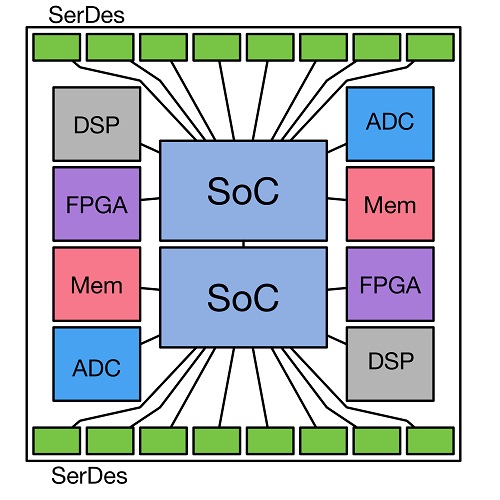 图 1: 可能的 MCM 布局范例
作为 USR 联盟的一个积极推动者,Marvell 公司正在努力建造一个关于互操作组件、互连、协议和软件的生态系统,以帮助半导体产业为市场带来更多价值。 USR 联盟正在与业界和其他标准开发组织合作,共同创建 PHY、MAC 和软件标准以及互操作性协议,同时为了确保广泛的互操作性,也在推动开发关于 USR 应用(包括认证计划)的完整生态系统。
欲了解关于 USR 联盟的详细信息,请访问: www.usr-alliance.org