



By Arifur Rahman, Director of Product Marketing, Custom Cloud Solutions, Marvell
Modern AI workloads are insatiable consumers of memory. Deep learning recommendation models (DLRM), large language model (LLM) inference, in-memory databases and vector search engines all share a common bottleneck: there is never enough DRAM, and what exists is very expensive.
At today's spot prices—$27–$37 per GB for server-grade DDR5 RDIMMs1—a 12TB memory pool requires nearly half a million dollars in DRAM alone. Meanwhile, AI infrastructure buildouts are consuming server DRAM capacity faster than fabs can produce it, driving prices up 300–400% since mid-2025.1, 2
CXL memory expansion was supposed to solve this. And it does—but there's a subtler lever that most solutions ignore: the data sitting in that memory is compressible, and most CXL controllers don't touch it.
By Claudia Hoessbacher, Senior Director, and Wolfgang Heni, Director, Optical Engineering, Marvell
Plasmons have been used to accelerate drug discovery, enhance the sensitivity of sensors and even create artistic treasures in the Roman era.
Ongoing research at Marvell seeks to harness them to improve the performance of optical networks for the AI era. Plasmonics, a technology that leverages the properties of surface plasmon polaritons (SPPs), provides a promising pathway for enhancing the roadmap of silicon photonic (SiPho) light engines, a critical component inside optical modules.
Plasmonic-based SiPho light engines could support modules operating at 3.2T and beyond while consuming a fraction of the space and power per bit of modules based on existing technologies. Manufacturers could leverage foundry process technologies for scaling production.
By Michael Kanellos, Head of Influencer Relations, Marvell
Data infrastructure needs more: more capacity, speed, efficiency, bandwidth and, ultimately, more data centers. The number of data centers owned by the top four cloud operators has grown by 73% since 20201, while total worldwide data center capacity is expected to double to 79 megawatts (MW) in the near future2.
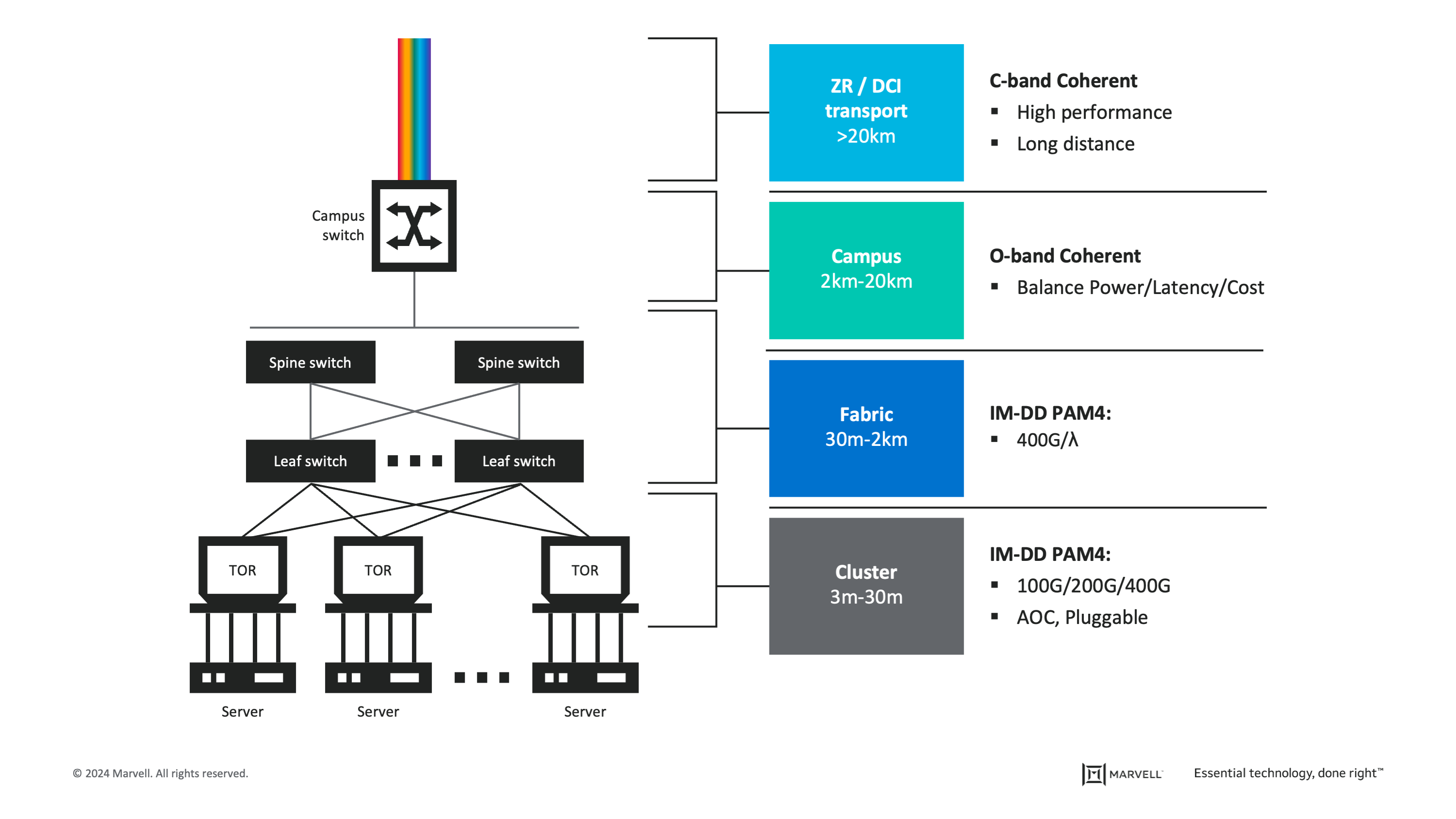
Aquila, the industry’s first O-band coherent DSP, marks a new chapter in optical technology. O-band optics lower the power consumption and complexity of optical modules for links ranging from two to 20 kilometers. O-band modules are longer in reach than PAM4-based optical modules used inside data centers and shorter than C-band and L-band coherent modules. They provide users with an optimized solution for the growing number of data center campuses emerging to manage the expected AI data traffic.
Take a deep dive into our O-band technology with Xi Wang’s blog, O-Band Coherent, An Idea Whose Time is (Nearly) Here, originally published in March, below:
O-Band Coherent: An Idea Whose Time Is (Nearly) Here
By Xi Wang, Vice President of Product Marketing of Optical Connectivity, Marvell
Over the last 20 years, data rates for optical technology have climbed 1000x while power per bit has declined by 100x, a stunning trajectory that in many ways paved the way for the cloud, mobile Internet and streaming media.
AI represents the next inflection point in bandwidth demand. Servers powered by AI accelerators and GPUs have far greater bandwidth needs than typical cloud servers: seven high-end GPUs alone can max out a switch that ordinarily can handle 500 cloud two-processor servers. Just as important, demand for AI services, and higher-value AI services such as medical imaging or predictive maintenance, will further drive the need for more bandwidth. The AI market alone is expected to reach $407 billion by 2027.
By Xi Wang, VP of Product Marketing of Optical Connectivity, Marvell
Over the last 20 years, data rates for optical technology have climbed 1000x while power per bit has declined by 100x, a stunning trajectory that in many ways paved the way for the cloud, mobile Internet and streaming media.
AI represents the next inflection point in bandwidth demand. Servers powered by AI accelerators and GPUs have far greater bandwidth needs than typical cloud servers: seven high-end GPUs alone can max out a switch that ordinarily can handle 500 cloud two-processor servers. Just as important, demand for AI services, and higher-value AI services such as medical imaging or predictive maintenance, will further drive the need for more bandwidth. The AI market alone is expected to reach $407 billion by 2027.
O-band coherent or coherent lite—a technology that has been discussed for years at conferences but has yet to be deployed commercially in a meaningful way--will likely begin to percolate into the market over the next few years to help cloud service providers accommodate some of these challenges.
By Radha Nagarajan, SVP and CTO of Optical Platforms, Marvell
This article was first published by Photonics Spectra
The cloud. It evokes an ethereal, weightless environment where problems get whisked away by a breeze.
In reality, the cloud consists of massive industrial buildings containing millions of dollars’ worth of equipment spread over thousands, and increasingly millions, of square feet. In Arizona, some communities are complaining that cloud data centers are draining their aquifers and consuming far more water than expected1 while in the UK and Ireland the power requirements of data centers are crimping needed housing development. Even in regions like Northern Virginia where the local economies are tightly bound to data centers, conflicts between residents and the cloud are emerging.
With the rise of AI, these conflicts will escalate. AI models and data sets are growing exponentially in size2 and developers are contemplating clusters with 32,000 GPUs, 2,000 switches, 4,000 servers and 74,000 optical modules3. Such a system might require 45MW of power capacity, or nearly 5x the peak load of the Empire State Building. This resource-intensiveness also shows how AI services could become an economic high wire act for many.
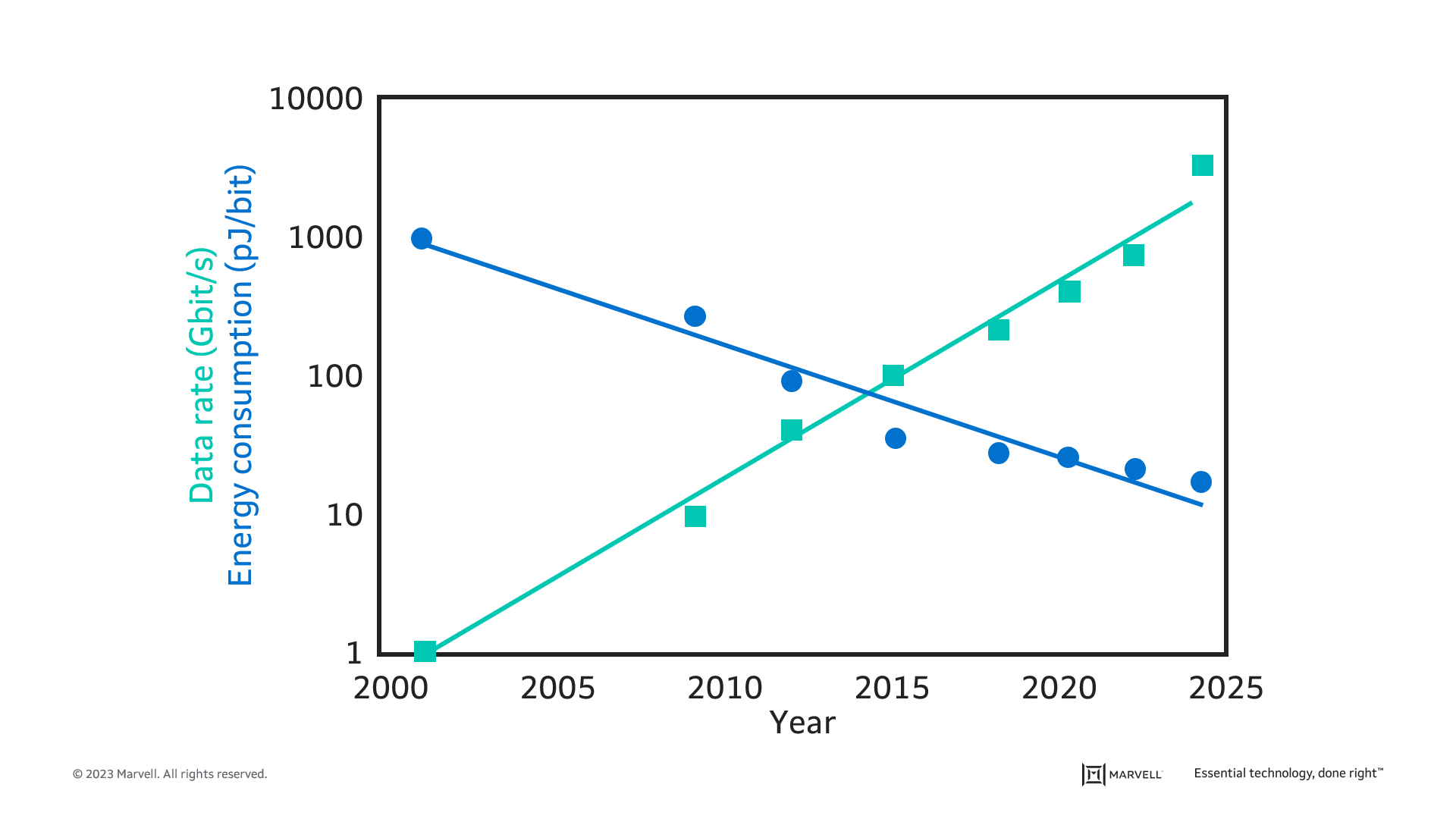
Performance up, Power Down: Over 20 years, the data rate of optical modules has increased by 1000x while power per bit has decreased by 100x.