



By Nicola Bramante, Senior Principal Engineer, Connectivity Marketing, Marvell
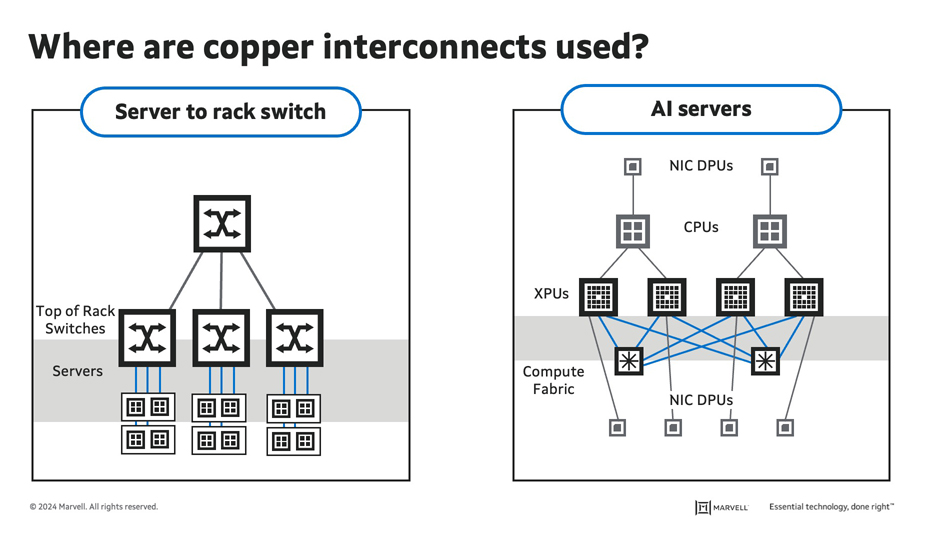
The exponential growth in AI workloads drives new requirements for connectivity in terms of data rate, associated bandwidth and distance, especially for scale-up applications. With direct attach copper (DAC) cables reaching their limits in terms of bandwidth and distance, a new class of cables, active copper cables (ACCs), are coming to market for short-reach links within a data center rack and between racks. Designed for connections up to 2 to 2.5 meters long, ACCs can transmit signals further than traditional passive DAC cables in the 200G/lane fabrics hyperscalers will soon deploy in their rack infrastructures.
At the same time, a 1.6T ACC consumes a relatively miniscule 2.5 watts of power and can be built around fewer and less sophisticated components than longer active electrical cables (AECs) or active optical cables (AOCs). The combination of features gives ACCs a peak mix of bandwidth, power, and cost for server-to-server or server-to-switch connections within the same rack.
Marvell announced its first ACC linear equalizers for producing ACC cables last month.
By Michael Kanellos, Head of Influencer Relations, Marvell and Vienna Alexander, Marketing Content Intern, Marvell
Is copper dead?
Not by a long shot. Copper technology, however, will undergo a dramatic transformation over the next several years. Here’s a guide.
1. Copper is the Goldilocks Metal
Copper has been a staple ingredient for interconnects since the days of Colossus and ENIAC. It is a superior conductor, costs far less than gold or silver and offers relatively low resistance. Copper also replaced aluminum for connecting transistors inside of chips in the late 90s because its 40% lower resistance improved performance by 15%1.
Copper is also simple, reliable and hearty. Interconnects are essentially wires. By contrast, optical interconnects require a host of components such as optical DSPs, transimpedance amplifiers and lasers.
“The first rule in optical technology is ‘Whatever you can do in copper, do in copper,’” says Dr. Loi Nguyen, EVP of optical technology at Marvell.
2. But It’s Still a Metal
Nonetheless, electrical resistance exists. As bandwidth and network speeds increase, so do heat and power consumption. Additionally, increasing bandwidth reduces the reach, so doubling the data rate reduces distance by roughly 30–50% (see below).
As a result, optical technologies have replaced copper in interconnects five meters or longer in data centers and telecommunication networks.
Source: Marvell
By Kristin Hehir, Senior Manager, PR and Marketing, Marvell

Marvell has been honored with two 2023 Lightwave Innovation Reviews high scores, validating its leadership in PAM4 DSP solutions for data infrastructure. The two awards reflect the industry’s recognition of Marvell’s recent best-in-class innovations to address the growing bandwidth and interconnect needs of cloud data center networks. An esteemed and experienced panel of third-party judges from the optical communications community recognized Marvell as a high-scoring honoree.
“On behalf of the Lightwave Innovation Reviews, I would like to congratulate Marvell on their high-scoring honoree status,” said Lightwave Editorial Director, Stephen Hardy. “This competitive program allows Lightwave to celebrate and recognize the most innovative products impacting the optical communications community this year.”
Marvell was recognized for the Marvell® Alaska® A PAM4 DSP Family for Active Electrical Cables (AECs) and the Marvell® Spica™ Gen 2 800G PAM4 Electro-Optics Platform, both in the Data Center Interconnect Platforms category. Key features of these 2023 Lightwave Innovation Reviews honorees include:


Copyright © 2026 Marvell, All rights reserved.